
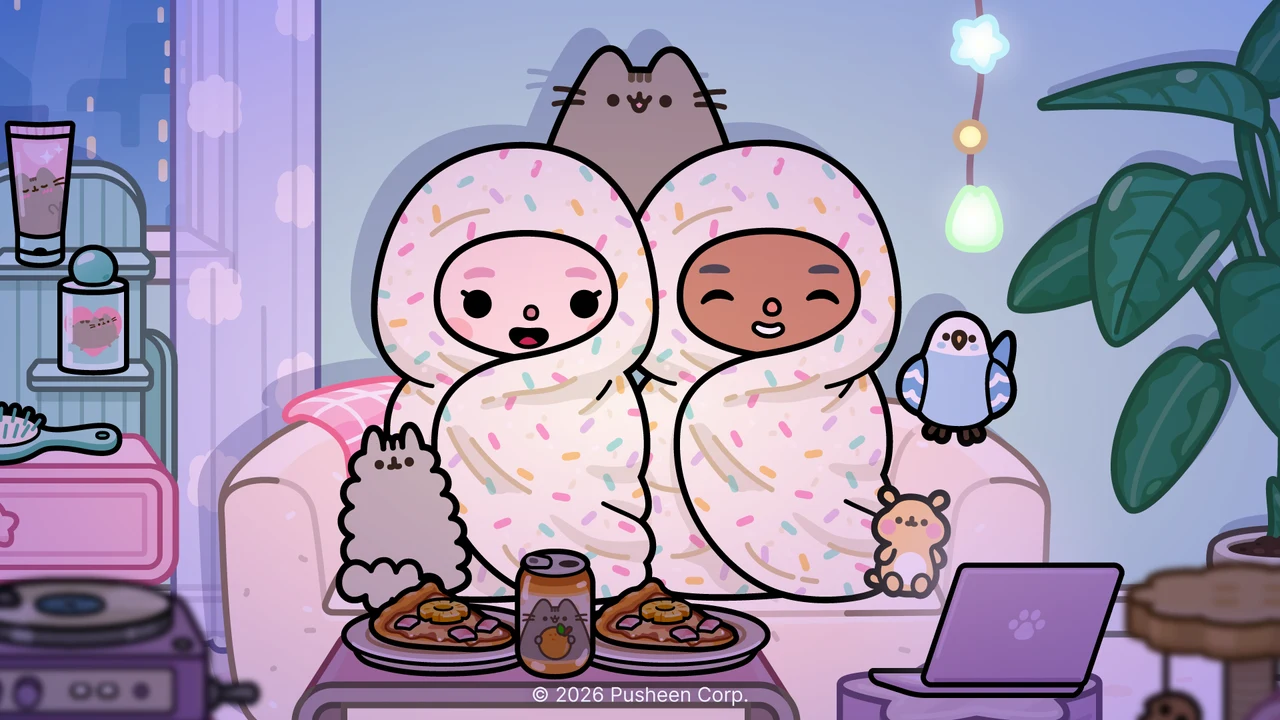
A house gives you the space; furniture gives that space a job. Before searching for another pack, decide what your room needs to do. A café needs somewhere to order and somewhere to sit. A bedroom needs a place to sleep and a little space that belongs to its character.
For Toca Boca All Unlocked players, the useful question is often which pieces to use together. This guide helps you choose a small set, keep track of its sources and make the room easy to play in.
Furniture packs, houses and style packs
These names describe different things. A house provides a layout. A furniture pack provides pieces to place in a room. Style content is associated with how characters look. A themed collection can include more than one kind of content, so check the items it actually lists.
The Pusheen collaboration artwork above is an example of a strong room theme: pastel furniture, character outfits and small objects share a recognizable style. The publisher’s Toca Boca World page describes the collaboration. The artwork is a visual reference, not a list of what is available in a particular Bocamod release.
Find the pieces around one activity
Choose a task the characters will do in the room. For an after-school hangout, start with seating and a place to leave a bag. For a small kitchen, think about preparing food and putting it somewhere to eat.
Look through the furniture choices for the large pieces first. Once the room’s purpose is clear, smaller objects become easier to choose. You can change the theme without changing every item.
Make a small furniture source list
Keeping track of a few pieces is more useful than trying to remember an entire catalog. Use a note or screenshot with three details: the object, its pack or category, and where it belongs in your room.
| Pick | Why it is there | What to record |
|---|---|---|
| Main seat | Gives a gathering place its shape | The pack or category where you found it |
| Table or counter | Supports the scene’s main activity | Its size beside the other furniture |
| Storage | Gives bags, books or props a home | Which objects the character uses most |
| One accent | Connects the room’s colors | The same color used somewhere else |
This is a planning list, not a claim that those are exact item names in the game. Use the names visible in your own catalog when you record the pieces.
Mix a theme without making the room busy
Choose one piece to lead the design. It might be a bright sofa, a patterned rug or a cheerful kitchen counter. Let the nearby pieces be quieter, then repeat a color from the main piece in a lamp or small decoration.
For the peach-and-mint apartment in our Home Designer guide, the sofa defines the gathering area and the table connects it to the kitchen. You can follow that relationship with completely different furniture.
Leave space for the characters
A room can look full in a picture and still be awkward for a story. Bring the cast in before finishing. Check whether the character can stand where the scene needs them, whether the important prop is visible and whether a visitor has somewhere to arrive.
If the game shows a house limit, work within it. Removing one decoration can make the room clearer. Keep the objects that explain the scene and save another idea for a different room.
Connect the room to the wider world
Give the room a destination outside it. A school bag can connect a bedroom to a school-day route. A particular outfit can belong to one of the characters you create.
To understand how houses, furniture, places and characters fit together, see the All Unlocked content guide. For a named pack, check the content of the release installed on your device.